When I started my teaching career, my philosophy and practice were both well-founded in the scoring systems most of us know very well. It felt like a flag salute: 90-100 = A, 80-89 = B, 70-79 = C, 60-69 = D, below 50 = F. The numbers were clean, the grades clear. Until AP Calculus happened.
Of course, we all meddled with the curve to fit the scores to something more humane. Add 5 points for your name, give everyone 12 Happy Friday points, make the test out of 85, or any other number-churning contraption we could concoct as teachers—especially math teachers.
Hearing that a 50/108 on the AP Calculus test was a passing score made similar sense. They were more precise than our unofficial ways of using our students’ numbers to mete out grades. That didn’t shake my faith one bit. I did, however, enjoy watching our shining math students struggle with the notion that 50/108 wasn’t an F.
Then it happened. 50/50.

The scores were released. All 50 of my students passed the AP Calculus exam. All 50/50 = 100% of the tests came back with a score of 3 or better on the AP Calculus AB or AP Calculus BC exam. Perfection. Apparent perfection at least.
A colleague approached me on hearing the news. Her excitement and joy couldn’t be contained as she poured out words of astonishment, excitement, and congratulations. “You’re like Jaime Escalante! Maybe they’ll make a movie about you too!!” What should have filled my tank and inspired me onward didn’t feel right. I knew that this time 50/50 wasn’t an A+.
Although happy and proud of my 50 students, I knew my roster count. Why only 50? I expected more than 50 results. What happened? Sure, some students didn’t sign up for the exam, yet others must have backed out last minute. Why? What if they took it? Would it have been 60/60? 50/60? What did 50/50 really mean?
When my department head approached me, the surge of pride welling up in me swallowed up my initial uncertainty. I couldn’t wait to hear the “Good job, Jeff” that was well deserved. Her words were perfect. She helped me clearly understand what 50/50 meant this time. We both knew it. She gave words to it.
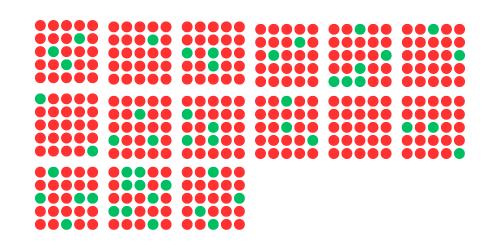
“What about all the other students? Who did we miss?”
Our school scored around 50/375 = 13%. Of all our students enrolled, only 50 passed. Why did only 50 take the test? What about the others?
F-
Understandably, not everyone wants to take Calculus. Not everyone necessarily even needs to take AP Calculus. However, we know that almost every human is capable of learning calculus. [Note: about 1-3% of the population have severe cognitive impairments that might preclude them.] Why were so few of our students taking Calculus? How many of our students could have taken that test and passed? Why only 50/50?
“If you know that you’re on the fence and are already thinking about dropping this course, please do so now.” I stood in awe as the administrator addressed my class at the start of the year. We had too many students enrolled in AP Calculus. Too many students to fit the schedule. I wouldn’t turn any student away. I certainly wouldn’t tell students to bail out before they gave it a try. Three of our top Pre-Calculus students from the previous year dropped AP Calculus class right after the administrator’s encouragement. All were promising mathematicians. All were girls.
We were doing it. I watched it happen. We limited the access to the course.
50/50 = F-
True, we weren’t like other schools I knew where students could sign up for the AP Calculus exam only with instructor approval. We let anyone take the exam and even provided financial assistance. Nonetheless, we sorted and select in our own way. We had barriers. We were failing our students. Our actions. Our inactions. Our system.
We were failing our students.
What would you say to young teacher Jeff to help him grow?
What would you say to your younger self to help you grow?
“There can be no keener revelation of a society’s soul than the way in which it treats its children.” – Nelson Mandela

 Grow, Jeff, Grow!
You must be logged in to post a comment.